 BULLSTAR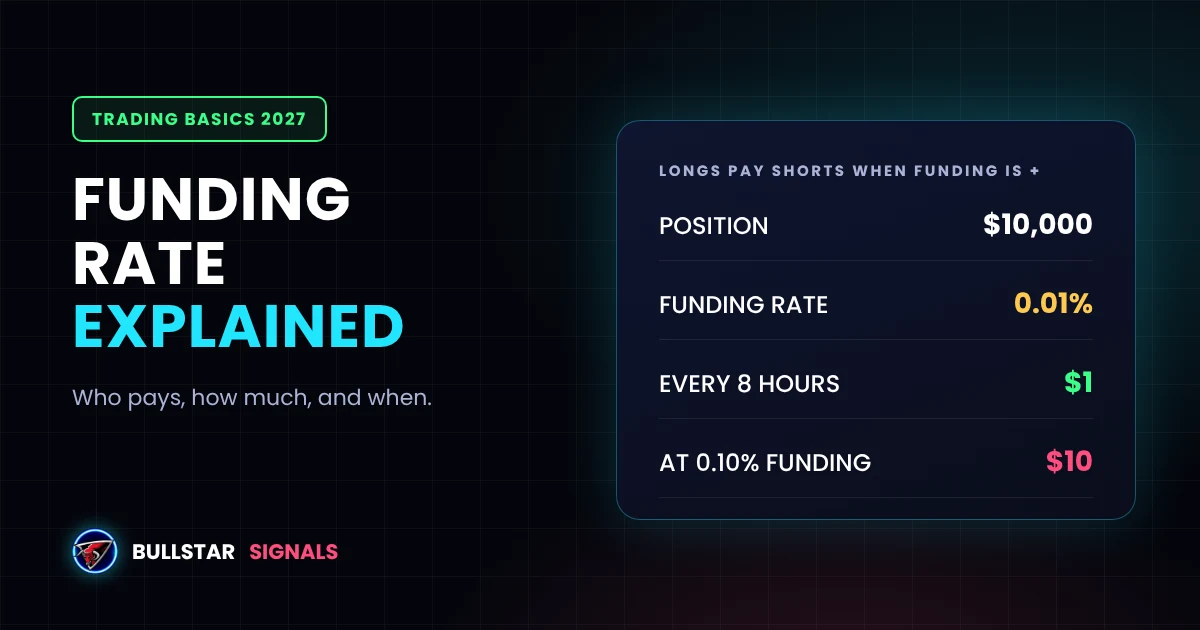
If you trade crypto futures on Binance, you have probably seen a small fee taken from your position every few hours, even when the price didn't move. That is the funding rate. Most of the time it is tiny and easy to ignore. But when the market gets crowded, funding can quietly eat a big part of a leveraged trade.
This guide explains what the funding rate is, who pays who, how to calculate what you pay, and when funding matters for your trades. There is also a free calculator below.
- What it is: a payment between longs and shorts that keeps the futures price close to the spot price.
- Positive funding: longs pay shorts. Negative funding: shorts pay longs.
- How much: position value x funding rate, usually every 8 hours. Normal is 0.01%.
- Who pays: only traders holding a position at the exact funding time.
What Is the Funding Rate?
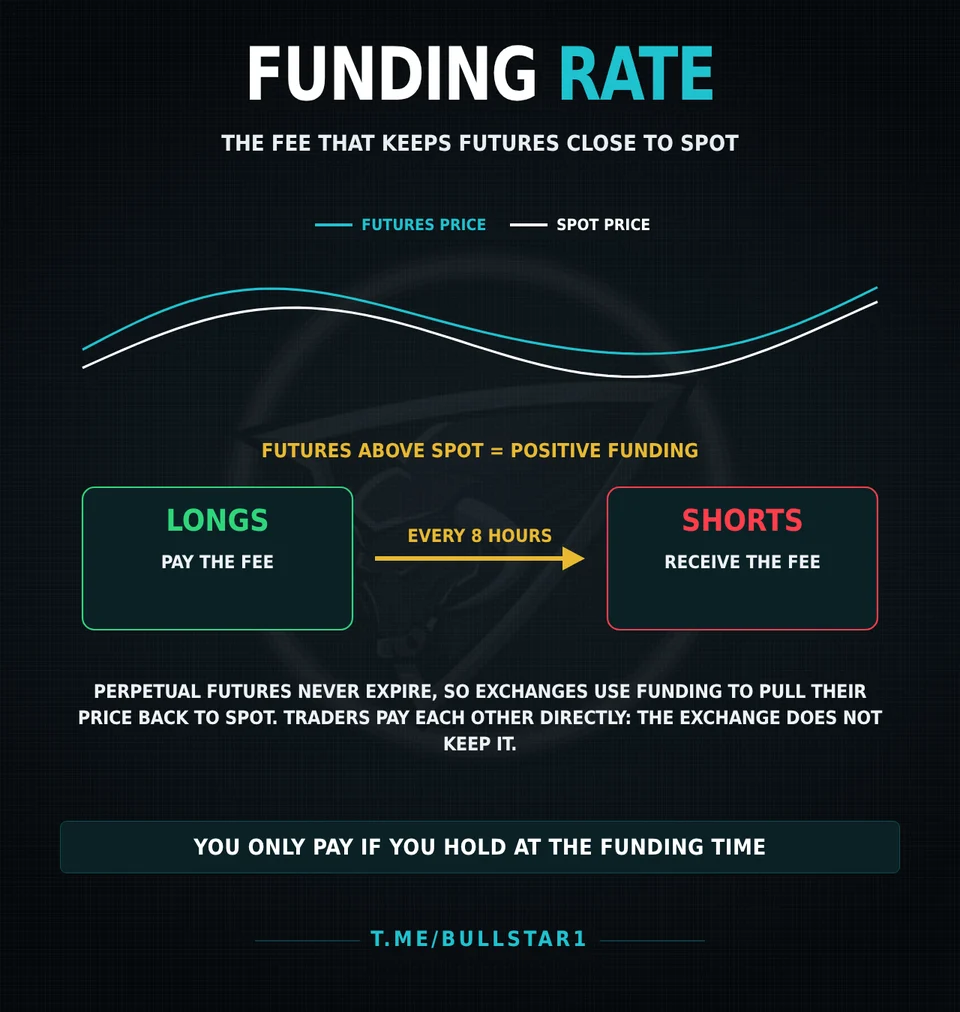
Crypto futures on Binance are mostly perpetual contracts. Unlike normal futures, they never expire, so nothing forces their price to meet the spot price on a set date. Without a fix, the futures price could drift far away from the real price of the coin.
The funding rate is that fix. When the futures price trades above spot, the funding rate turns positive and traders who are long pay traders who are short. That makes longs more expensive to hold and shorts more attractive, which pushes the futures price back down toward spot. When futures trade below spot, it works the other way.
One thing surprises many beginners: the exchange doesn't keep the funding fee. It goes directly from one group of traders to the other. It is separate from the trading fees you pay when you open and close a position.
Positive vs Negative Funding: Who Pays Who
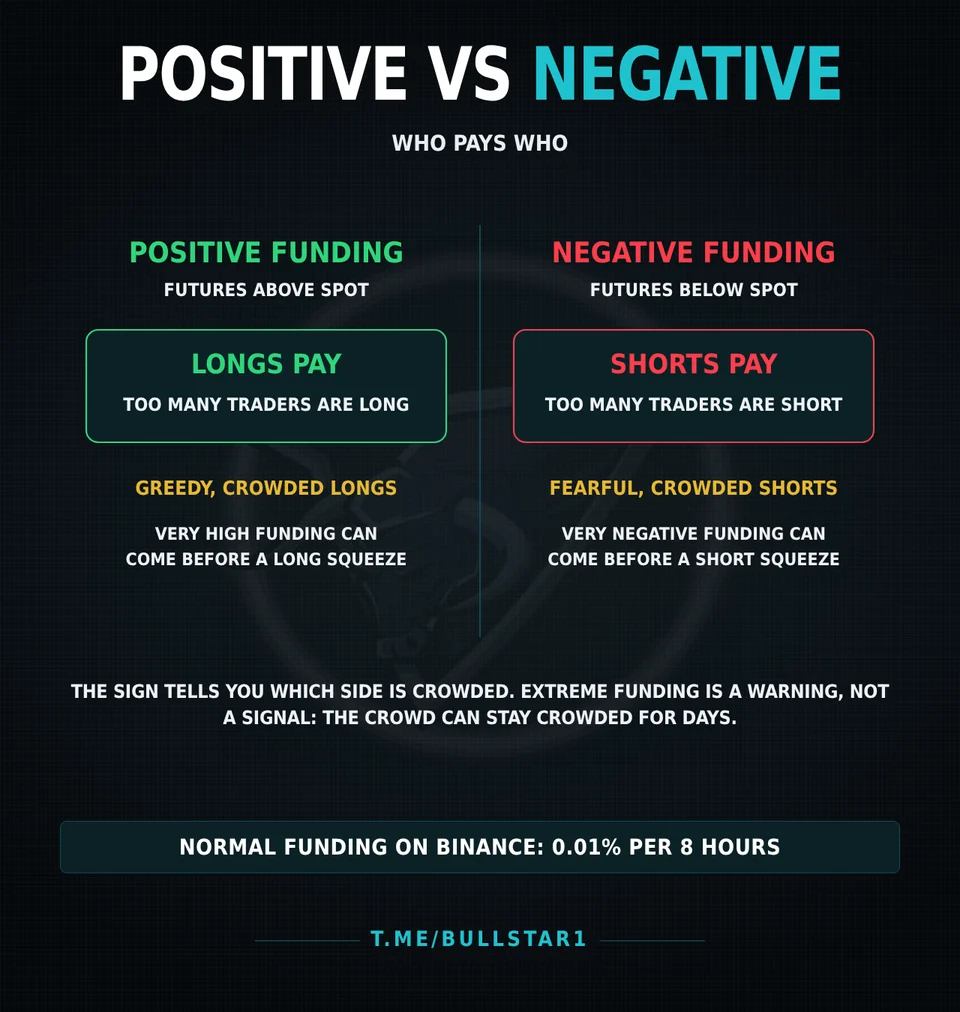
- Positive funding (+): futures are above spot. Longs pay shorts. Usually means more traders are betting on the price going up.
- Negative funding (-): futures are below spot. Shorts pay longs. Usually means more traders are betting on the price going down.
On Binance, the default funding rate is 0.01% per 8 hours. In calm markets most major coins sit at or near that number for long stretches. When you see funding far above it, or deep in negative territory, it means one side of the market is crowded.
How the Funding Rate Is Calculated
The rate itself is set by the exchange from two parts: an interest component (0.01% per 8 hours on Binance) and a premium that measures how far the futures price is from the index price. You don't need to calculate the rate yourself. Binance shows the current rate and a countdown to the next payment above the chart of every contract.
What you do need to know is how much you pay:
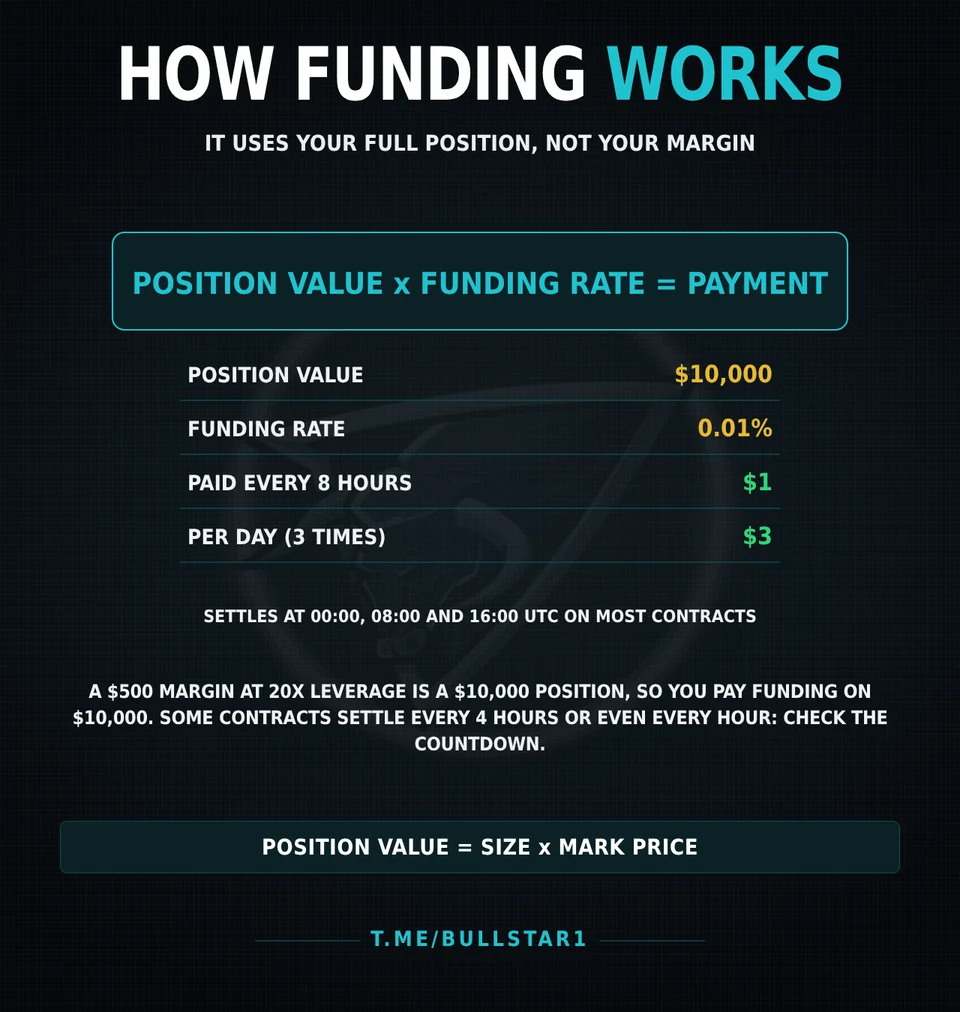
Funding payment = Position value x Funding rate
The position value is your full position (size x mark price), not your margin. That is the part most traders miss. A $500 margin at 20x leverage is a $10,000 position, so you pay funding on $10,000.
Example: you hold a $10,000 long and funding is 0.01%. You pay $1 at each funding time. With three payments a day, that is $3 per day. If funding jumps to 0.1%, the same position pays $10 every 8 hours, or $30 a day.
On most Binance contracts, funding is paid at 00:00, 08:00 and 16:00 UTC. Some contracts settle every 4 hours, and Binance can switch a contract to hourly funding when the rate hits its limit. Always check the countdown on the contract you trade.
Funding Rate Calculator
Enter your margin, leverage and the current funding rate to see what funding costs (or pays) you.
Assumes the funding rate stays the same. In real markets it changes every period.
Why Funding Matters More With Leverage
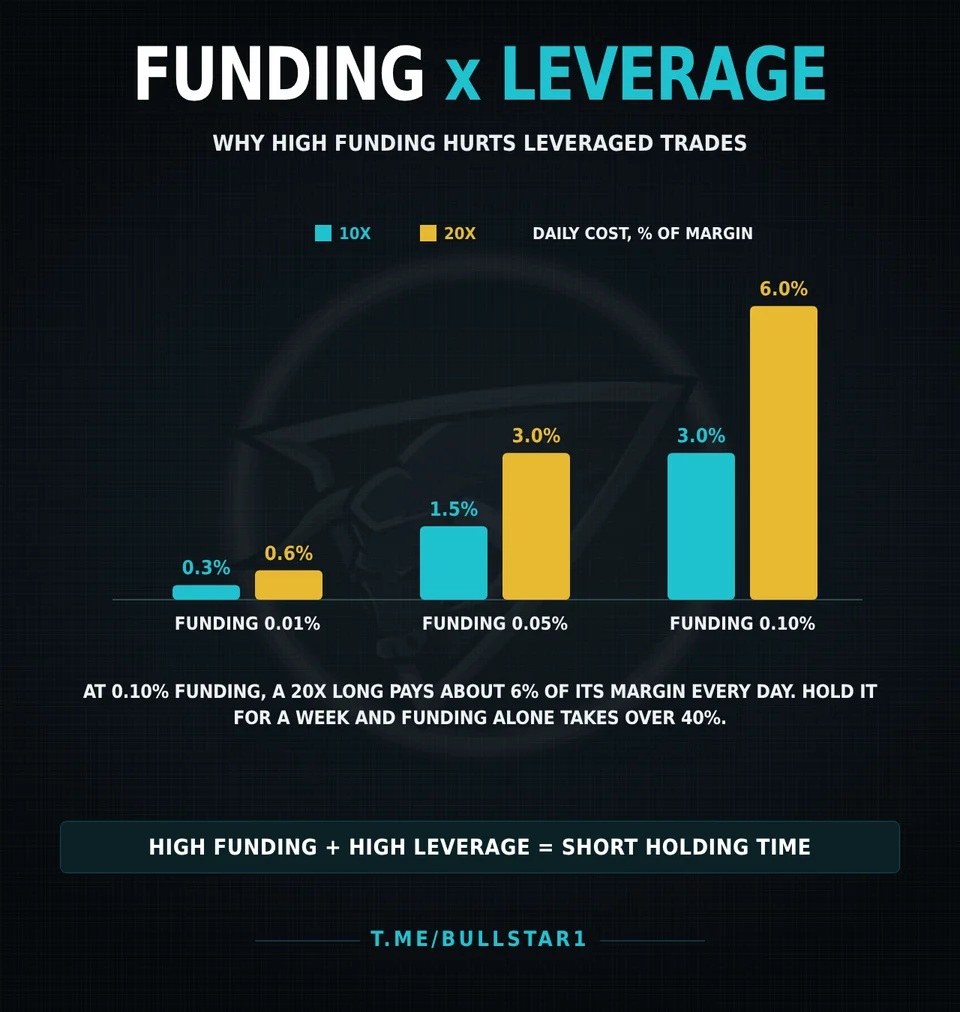
The funding rate is a percent of your position, but you feel it as a percent of your margin. The higher your leverage, the bigger that hit:
- At the normal 0.01%, a 10x position pays about 0.3% of its margin per day. A 20x position pays about 0.6%.
- At 0.1%, the same 20x long pays about 6% of its margin every day. Hold it for a week and funding alone takes more than 40%.
That is why high funding and high leverage don't mix with long holding times. If you plan to keep a leveraged trade open for days, check the funding rate first and size the position with our position size calculator. If you want to understand how leverage changes the rest of the math, read leverage explained.
Can You Avoid Paying Funding?
Yes, in a few honest ways:
- Close before the funding time. If you don't hold a position at the exact funding timestamp, you don't pay or receive anything. Short scalps often avoid funding completely.
- Use lower leverage. Less leverage means a smaller position for the same margin and a smaller funding payment.
- Trade with the funding, not against it. When funding is very positive, shorts get paid to wait. When it is very negative, longs get paid.
- Use spot for long-term holds. Spot has no funding at all. Our guide on spot vs futures explains when each one makes sense.
Funding Rate as a Market Signal
Because funding shows which side is crowded, many traders watch it as a sentiment gauge:
- Very high positive funding means a lot of traders are long with leverage. If price starts to fall, those longs get stopped out or liquidated, and the selling can speed up the drop. This is often called a long squeeze.
- Very negative funding means shorts are crowded. A sudden move up can force them to close, which pushes the price higher. That is a short squeeze.
Treat extreme funding as a warning, not a trade signal by itself. A crowded market can stay crowded for days. Funding works best next to price structure, like support and resistance, and a clear stop loss.
How to Check the Funding Rate on Binance
- Open Futures and pick the contract, for example BTCUSDT Perpetual.
- Look at the top bar above the chart: Funding / Countdown shows the current rate and the time to the next payment.
- To see past rates, open the contract info and go to the funding rate history.
- After a payment, you can find it in your Transaction History under funding fee.
New to Binance Futures? Start with our step-by-step guide.
Funding and Signal Trading
When you follow futures signals, funding is part of your real result. A signal that takes two days to reach its targets will collect or pay six funding payments along the way. At normal rates that is a small cost. In a crowded market with high leverage, it can be the difference between a small win and a small loss.
Our VIP signals come with an entry zone, several targets and a stop loss, and many of them close within a day or two. If you want to see how our signals play out, every VIP signal since 2022 is listed on our results page, and you can follow the free Telegram channel before you decide anything.
Not financial advice. Futures trading with leverage carries high risk.