 BULLSTAR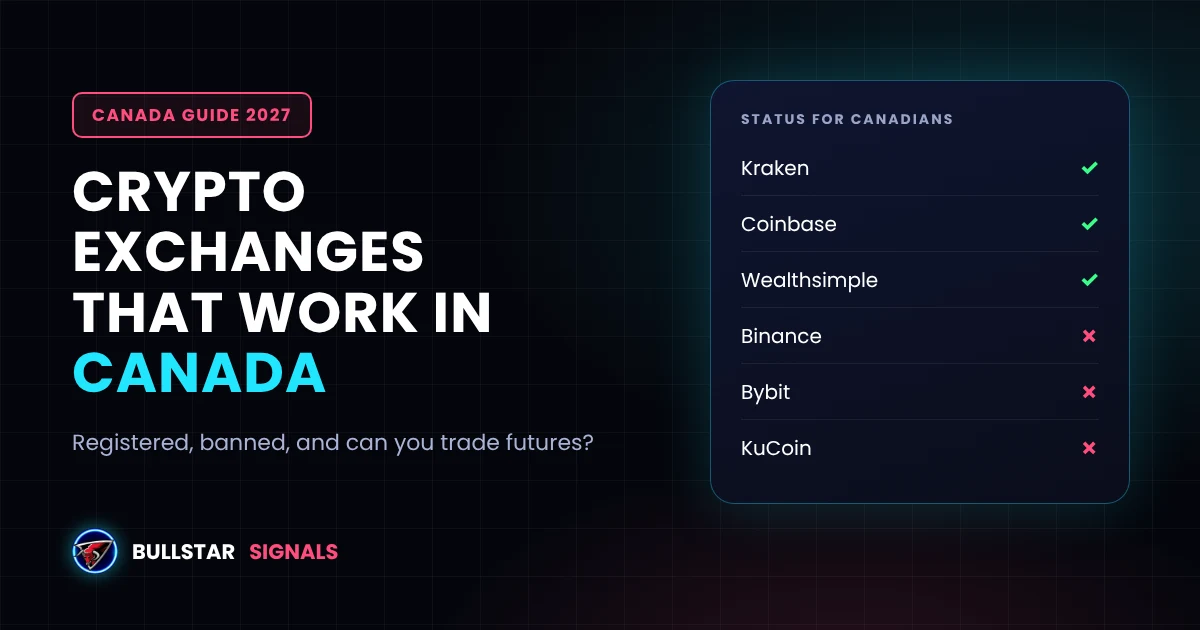
If you live in Canada and try to sign up for Binance, Bybit or OKX, you'll find they're no longer available. Canada has some of the strictest crypto rules in the world, and many big exchanges have left. So which crypto exchanges actually work in Canada in 2027, which ones are banned, and can you still trade crypto futures?
This guide answers all of that, using the official list from the Canadian Securities Administrators (CSA). It also shows how Canadians can follow crypto signals legally, on spot, without leverage.
The crypto exchanges that legally serve Canadians are the ones registered with Canadian securities regulators, such as Kraken, Coinbase, Crypto.com, Wealthsimple, Newton, Shakepay, NDAX, Netcoins and Coinsquare. Binance, Bybit and OKX left Canada in 2023, and KuCoin is banned. Registered platforms offer spot trading only for retail clients, with no leverage.
How Crypto Exchanges Are Regulated in Canada
In Canada, crypto trading platforms are regulated by the provincial and territorial securities regulators, who work together as the CSA. Any platform that serves Canadians, including ones based outside Canada, must be registered. Registered platforms have to:
- Protect clients' crypto and cash, including how it's stored
- Manage risks such as cybersecurity
- Limit which crypto assets they offer
- Deliver your crypto or cash to you when you ask for it
- Give clients clear information about risks
The CSA publishes an official list of authorized platforms, and a separate list of banned ones. It recommends that Canadians only use registered platforms. You can check both lists yourself on the CSA website.
Crypto Exchanges That Work in Canada (2027)
These platforms are on the CSA list of crypto platforms authorized to do business with Canadians, as of October 2026. They can serve clients across Canada unless noted otherwise.
| Platform | Company registered | Good to know |
|---|---|---|
| Kraken | Payward Canada Inc. | Large global exchange with a wide coin list and an advanced trading screen |
| Coinbase | Coinbase Canada Inc. | Easy app for beginners, plus an advanced trading view |
| Crypto.com | Foris DAX CAN ULC | Global crypto app, registered in Canada in 2025 |
| Wealthsimple | Wealthsimple Investments Inc. | Crypto next to stocks and ETFs in one Canadian app |
| Newton | Newton Crypto Ltd. | Canadian platform focused on simple buying and selling |
| Shakepay | Shakepay Inc. | Canadian app built for simple buying, popular for Bitcoin |
| NDAX | Ndax Canada Inc. | Canadian exchange with an order-book trading screen |
| Netcoins | Netcoins Inc. | Canadian platform for buying and selling crypto |
| Coinsquare | Coinsquare Capital Markets Limited | One of the longest-running Canadian platforms |
| Webull | Webull Canada Crypto Limited | Trading app, registered for crypto in Canada in 2026 |
| Fidelity | Fidelity Clearing Canada ULC | Crypto access for clients of Fidelity in Canada |
A few more platforms are registered but can only serve certain provinces, or are winding down:
| Platform | Where it can operate |
|---|---|
| Satstreet | Ontario, Alberta, British Columbia, Manitoba, Quebec and Saskatchewan only |
| Hibit Technology | Alberta, British Columbia, Manitoba and Saskatchewan only |
| Cybrid Canada | Ontario only |
| VirgoCX | Registered, but under terms requiring it to wind down its registrable business |
Exchanges That Don't Work in Canada
Several of the world's biggest exchanges are not available to Canadians. Some left on their own after the rules changed in 2023, and others have been banned by Canadian regulators.
| Exchange | Status for Canadians |
|---|---|
| Binance | ✗ Left Canada in 2023 |
| Bybit | ✗ Left Canada in 2023 |
| OKX | ✗ Left Canada in 2023 |
| KuCoin | ✗ On the CSA list of banned platforms |
| Poloniex | ✗ On the CSA list of banned platforms |
| CoinEx | ✗ On the CSA list of banned platforms |
| XT.COM | ✗ On the CSA list of banned platforms |
Some websites suggest using a VPN or a foreign account to access these exchanges anyway. We don't recommend it. You would be using a platform that isn't allowed to serve you, so if something goes wrong, from a frozen account to a withdrawal problem, you have very little protection. The full list of banned platforms is on the CSA website.
Can You Trade Crypto Futures in Canada?
For most Canadians, the short answer is no, not on a registered platform. Under the terms of their registration, Canadian crypto platforms generally can't offer margin, credit or other forms of leverage to retail clients. Only some platforms may offer it to "permitted clients", such as institutions and individuals with over $5 million in net financial assets.
That means the leveraged futures trading you see on Binance Futures or Bybit isn't available to a regular Canadian investor through a registered platform. What you can do is trade spot: buy a coin, own it, and sell it later.
| Crypto futures (outside Canada) | Spot on a registered Canadian platform | |
|---|---|---|
| Leverage | Yes, often 5x to 20x | ✗ No, retail clients can't use margin or leverage |
| Short trades | Yes | No, you can only buy and later sell |
| Liquidation risk | Yes | ✓ No, you own the coins |
| Coin choice | Hundreds of pairs | Smaller list, varies by platform |
| How a signal is used | Long or short, with leverage | Long signals only: buy at entry, sell at targets |
Spot has a real advantage: there's no liquidation. If the price drops, you still own the coin. Our guides on spot vs futures trading and liquidation explain the difference in more detail.
The C$30,000 Limit on Altcoins
There's one more rule many Canadians don't know about. In many provinces, retail investors who don't qualify as "eligible investors" can only put up to C$30,000 over 12 months into crypto assets other than Bitcoin, Ether, Litecoin and Bitcoin Cash. Those four coins have no limit.
Your platform will usually ask a few questions when you open an account to decide which category you're in, and it tracks the limit for you. If you trade a lot of altcoins, keep this limit in mind.
How to Choose a Crypto Exchange in Canada
- Registered first. Only consider platforms on the CSA list. Everything else comes second.
- Coin list. If you follow signals on altcoins, choose a platform with a large coin list, and check that the coins you trade are available.
- Order types. Limit orders and stop orders make it much easier to follow a trading plan. Simple buy-and-sell apps may not have them.
- Fees and spreads. Some apps show "no fees" but build the cost into the price you pay (the spread). Compare the total cost of a trade, not just the fee line.
- Deposits and withdrawals. Check how you can add Canadian dollars, such as Interac e-Transfer, and what withdrawals cost.
For active trading with signals, platforms with an order-book trading screen and a wide coin list are usually the better fit. For simply buying and holding Bitcoin, a simpler app is often enough. Our general exchange comparison covers what matters most for signal traders.
How to Follow Crypto Signals in Canada (Spot Only)
You can still use crypto signals in Canada. You just use them on spot, without leverage. Remember that a signal is a trade idea, not financial advice: you decide whether to take it and how much to risk. Here's how:
- Check the coin is listed on your platform before the signal comes. Not every altcoin is available in Canada.
- Follow long signals only. On spot you can't short, so skip "short" signals.
- Buy inside the entry zone with a limit order if your platform has one, so you don't chase the price.
- Set your stop loss. If the platform supports stop orders, use them. If not, set a price alert and sell manually when it triggers.
- Take profit in parts at the targets, for example a third at each of the first three targets.
- Risk 1-2% per trade. Without leverage your position is bigger, so size it by the distance to your stop loss. Our position size calculator does the math.
New to signals? Start with our guide to reading a trading signal.
Bullstar Signals posts signals with an entry zone, several targets and a stop loss on every trade. Canadian members can follow the long signals on spot, on a registered Canadian platform, as long as the coin is listed there. Try our free channel first and see if it fits your style.
Our signals are trade ideas shared for educational purposes only. They are not financial advice or a recommendation to buy or sell. You decide every trade yourself, and you are responsible for your own results.
Join Bullstar Signals free channelCrypto Taxes in Canada
The Canada Revenue Agency (CRA) treats crypto as a commodity. Depending on how often and how you trade, your profits are taxed either as capital gains or as business income. Every sale, trade between coins, or purchase with crypto can count as a taxable event. Keep a record of every trade, including the date, amount and value in Canadian dollars, and check with a tax professional if you trade often.
Frequently Asked Questions
Is Binance allowed in Canada?
No. Binance stopped serving Canadian users in 2023, after Canadian securities regulators introduced stricter rules for crypto platforms. It is not on the CSA list of platforms authorized to do business with Canadians.
Which crypto exchanges are legal in Canada?
The platforms on the CSA list of crypto platforms authorized to do business with Canadians, as of October 2026, include Kraken, Coinbase, Crypto.com, Wealthsimple, Newton, Shakepay, NDAX, Netcoins, Coinsquare, Webull and Fidelity, plus a few that only serve certain provinces. Always check the official CSA list, because it changes.
Can I trade crypto futures in Canada?
Registered Canadian crypto platforms generally can't offer margin, credit or leverage to retail clients, so crypto futures with leverage are not available to most Canadians on these platforms. Using unregistered foreign exchanges to get around this is not recommended by regulators, because your funds may not be protected.
Is there a limit on how much crypto I can buy in Canada?
In many provinces, retail investors who don't qualify as eligible investors have a C$30,000 limit over 12 months on crypto assets other than Bitcoin, Ether, Litecoin and Bitcoin Cash. There is no such limit for those four coins. Your platform will explain the limit when you open an account.
Can I follow crypto signals from Canada?
Yes, on spot. You can follow long signals on a registered Canadian platform by buying at the entry and selling at the targets, without leverage. Make sure the coin is listed on your platform and always use a stop loss.
Is KuCoin banned in Canada?
Yes. KuCoin is on the list of crypto platforms banned in one or more Canadian jurisdictions, published by the Canadian Securities Administrators.
Do I pay tax on crypto in Canada?
Yes. The Canada Revenue Agency treats crypto gains as either capital gains or business income, depending on how you trade. Keep a record of every trade and check with a tax professional.
Final Thoughts
Crypto trading is legal in Canada, but only through registered platforms, and only on spot for most people. Binance, Bybit and OKX are gone, KuCoin is banned, and leveraged futures aren't available to regular investors on registered platforms. That's frustrating if you're used to futures, but it also means no liquidations and better protection for your money.
Pick a registered platform from the official CSA list, check that it has the coins you want, and follow every trade with a stop loss and small position sizes.
Disclaimer: This guide is for information only and is not financial, legal or tax advice. Platform registrations are based on the CSA list as of October 2026 and can change at any time. Always check the official CSA website before opening an account. Crypto trading carries a high risk of loss.