 BULLSTAR
Every trader knows they should use a stop loss. The hard part is knowing where to put it. Too tight, and normal price noise stops you out right before the move you predicted. Too wide, and one losing trade takes a big bite out of your account.
This guide covers the five stop loss methods that actually work in crypto, how to avoid the stop hunts that catch most beginners, how to size your position from the stop, and how to set a stop loss on Binance Futures.
- The rule: put your stop where your trade idea is proven wrong, not at a random percentage.
- For longs: just below the last swing low, trendline or key moving average.
- For shorts: just above the last swing high.
- Then: size the position so hitting the stop costs only 1-2% of your account.
What Is a Stop Loss?
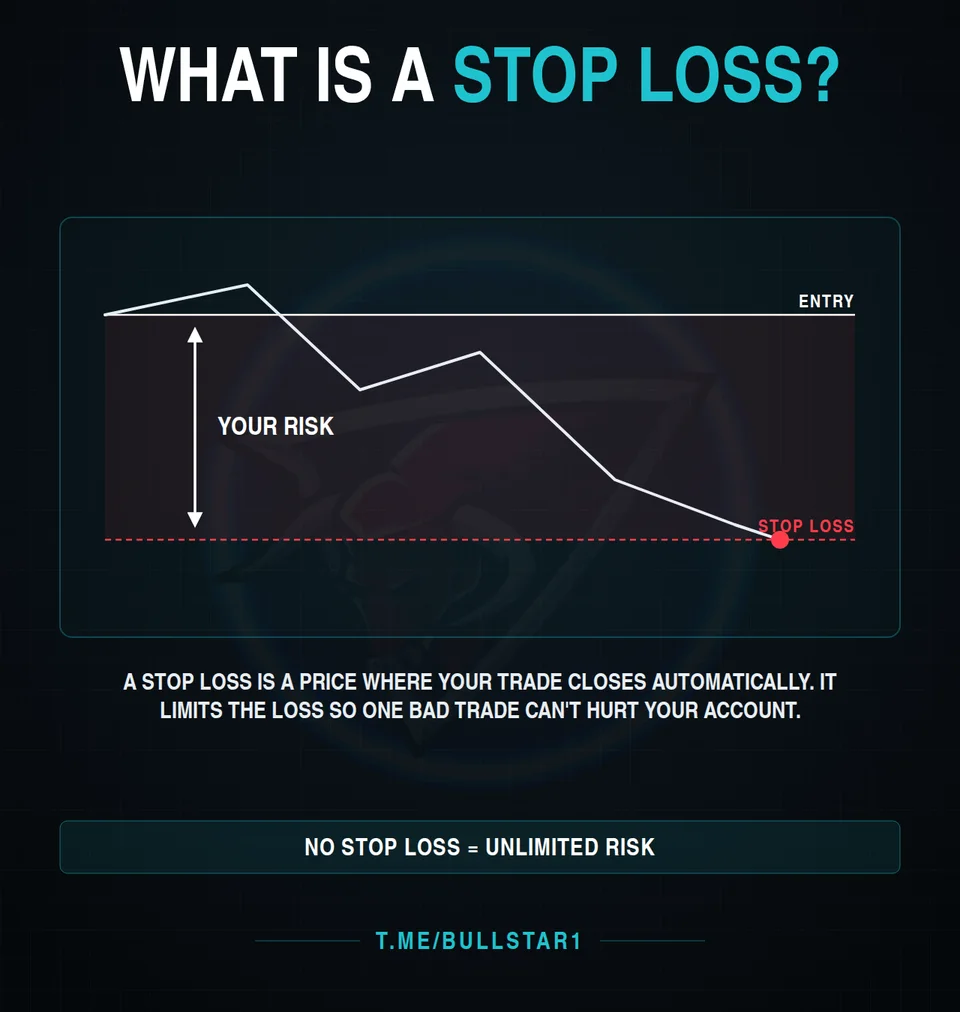
A stop loss is a price where your trade closes automatically. The distance between your entry and your stop is your risk on that trade. Its job is simple: to make sure one bad trade can't hurt your account.
Without a stop loss, your risk is unlimited. In crypto, where a coin can drop 20% in an hour and leverage multiplies every move, that is how accounts get wiped out. Our guide on futures liquidation shows exactly how fast it happens.
The Golden Rule: Put Your Stop Where You're Wrong
Most beginners pick a stop based on how much they're willing to lose, like "5% below entry". The problem is that the market doesn't care about your 5%. A better question is: at what price is my trade idea clearly wrong?
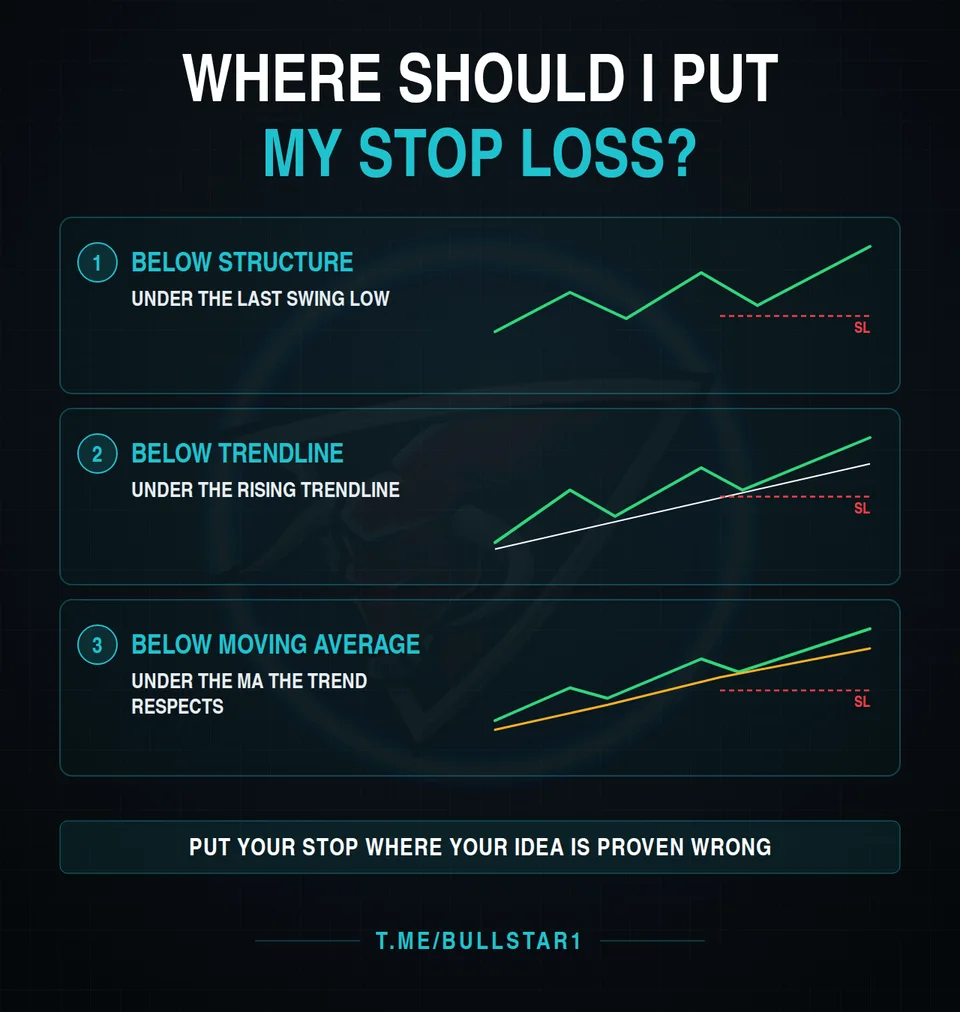
If you bought because price bounced from support, your idea is wrong when support breaks. That's where the stop belongs. Here are the five methods most traders use to find that price:
Method 1: Below Market Structure
The most common method. In an uptrend, price makes higher lows. Put your stop just below the last higher low. If price breaks it, the uptrend structure is broken and your reason for the trade is gone. For shorts, the stop goes just above the last lower high.
Method 2: Below the Trendline
When price respects a rising trendline, place the stop just below it. A clean break of the trendline means the trend is weakening. This works best when the trendline has been tested at least three times.
Method 3: Below a Moving Average
In strong trends, price often pulls back to the same moving average, like the 20 or 50 EMA, and bounces. If you buy one of those bounces, put the stop below the moving average the trend has been respecting.
Method 4: The ATR Stop
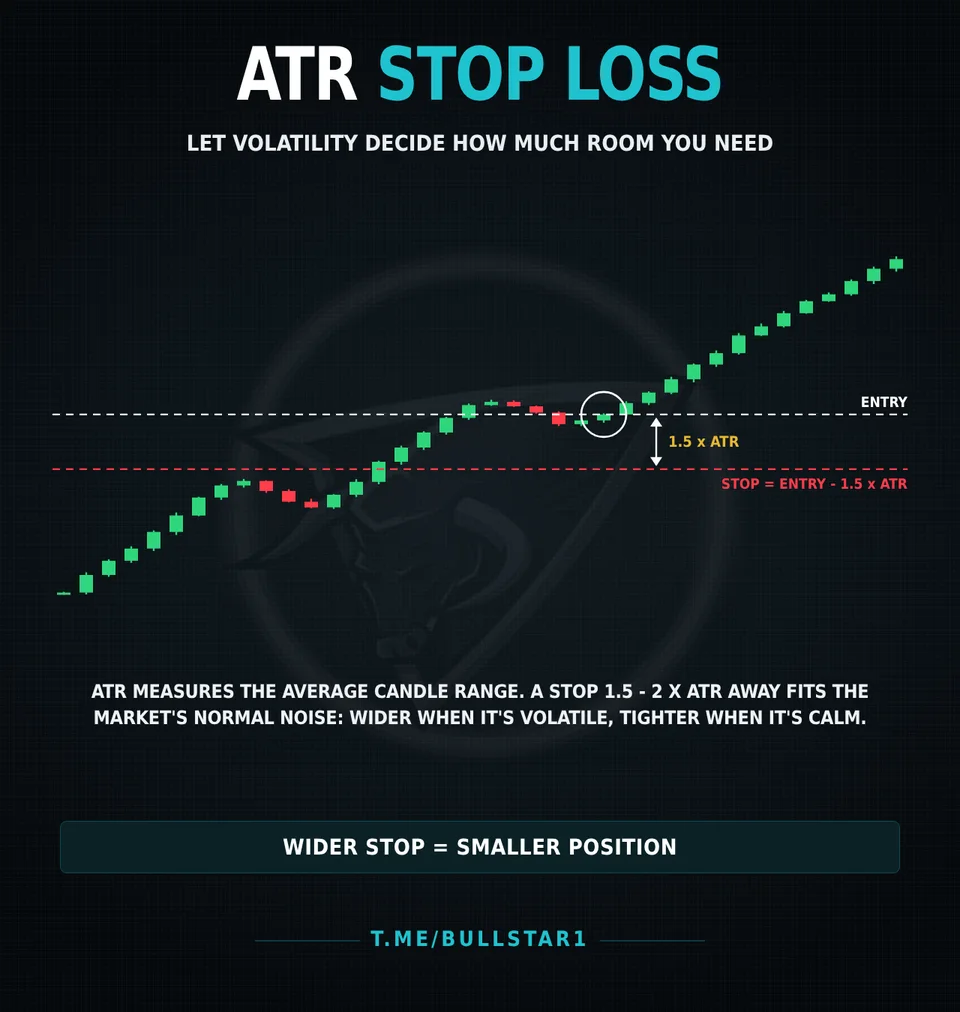
The Average True Range (ATR) measures how much a coin usually moves in one candle. A stop placed 1.5 to 2 times the ATR away from your entry gives the trade room for normal noise. When the market is volatile, the stop is automatically wider. When it's calm, it's tighter.
A wider stop is not more risk, as long as you make the position smaller. More on that below.
Method 5: Beyond the Pattern or Fibonacci Level
If you trade a chart pattern, the pattern tells you where it fails: above the right shoulder in a head and shoulders, below the flag in a bull flag, below the handle in a cup and handle. Our chart patterns cheat sheet shows the stop for each one. If you buy a Fibonacci pullback, a common stop is just beyond the 78.6% level, as explained in our Fibonacci retracement guide.
Don't Put Your Stop in the Obvious Place
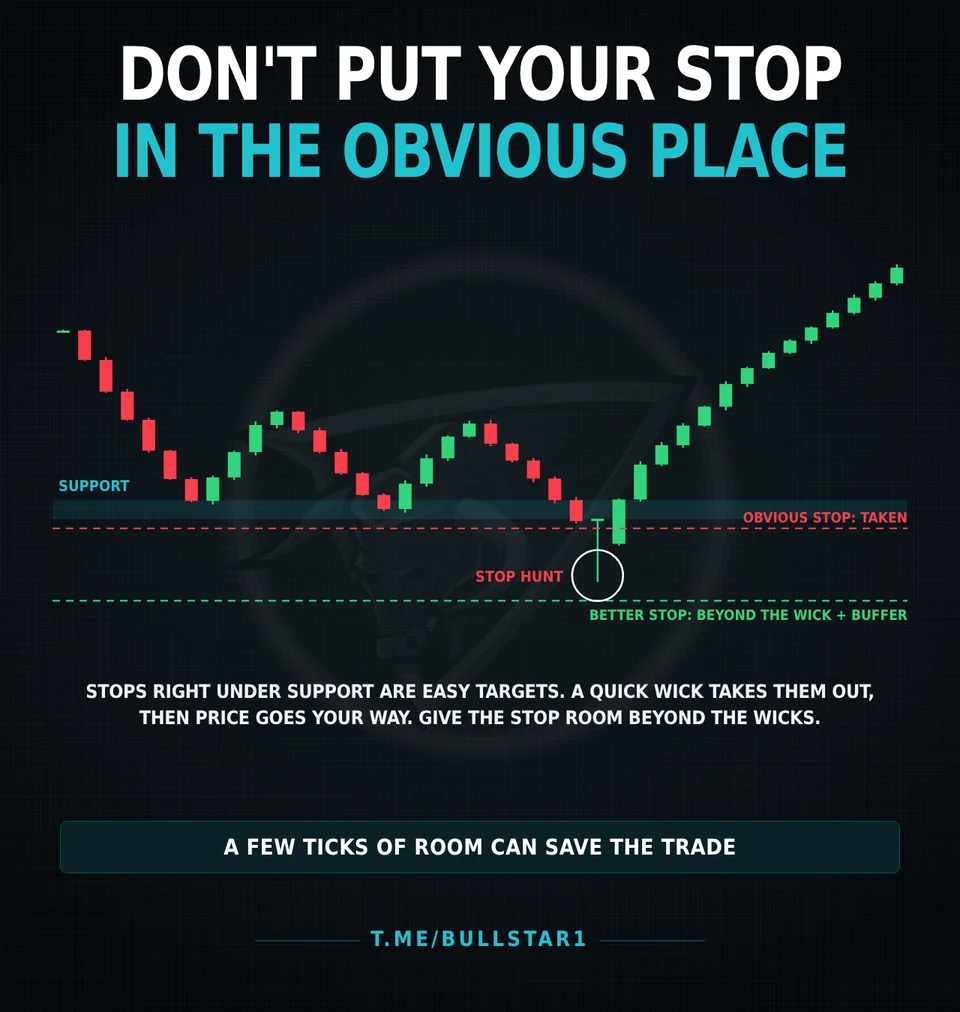
Here's what catches most traders: everyone puts their stop right under the same support level. That creates a pool of orders that larger players can trigger with a quick wick, before price goes exactly where you expected.
To avoid this:
- Place the stop a little beyond the wicks, not just beyond the candle bodies.
- Add a small buffer, for example a fraction of the ATR.
- Avoid round numbers. A stop at $59,950 is more likely to get hit than one at $59,720 below a $60,000 support.
Stop hunts are more common in quiet hours and on weekends, when liquidity is thin. Our guide on the best time to trade crypto shows when volume is lowest.
Size Your Position From the Stop, Not Your Feelings
This is the part that turns a stop loss into real risk management. First decide where the stop goes. Then calculate the position size so that hitting the stop costs only a small, fixed part of your account, usually 1-2%.
With this method, a wide stop simply means a smaller position, and a tight stop means a bigger one. Your loss on a bad trade stays the same. Leverage only changes how much margin you need, not how much you lose if the stop is hit. Our position size calculator does this math for you.
Your stop loss must always be well before your liquidation price. If the liquidation price comes first, your stop is useless. With high leverage, liquidation can be very close to your entry. Our leverage guide explains why lower leverage is safer.
How to Set a Stop Loss on Binance Futures
- When opening the trade: tick the TP/SL box in the order panel and enter your stop loss price before you click Buy/Long or Sell/Short.
- After opening: go to the Positions tab, find your position and use the TP/SL option to add or edit the stop.
- Choose the trigger: Mark price is less affected by sudden wicks on one exchange. Last price reacts to the actual traded price.
- Check the order: make sure the stop appears in your open orders and is on the correct side of the price.
Our step-by-step Binance Futures guide covers the full process, and if you follow signals, Cornix can place the stop loss for you automatically.
Moving Your Stop: Breakeven and Trailing Stops
- Breakeven: once price reaches the first target, moving the stop to your entry removes the risk from the trade. Just don't do it too early.
- Trailing stop: the stop follows price at a set distance, locking in profit in strong trends.
- Never move the stop further away to avoid a loss. That turns a small planned loss into a big unplanned one.
Why Traders Don't Use a Stop Loss
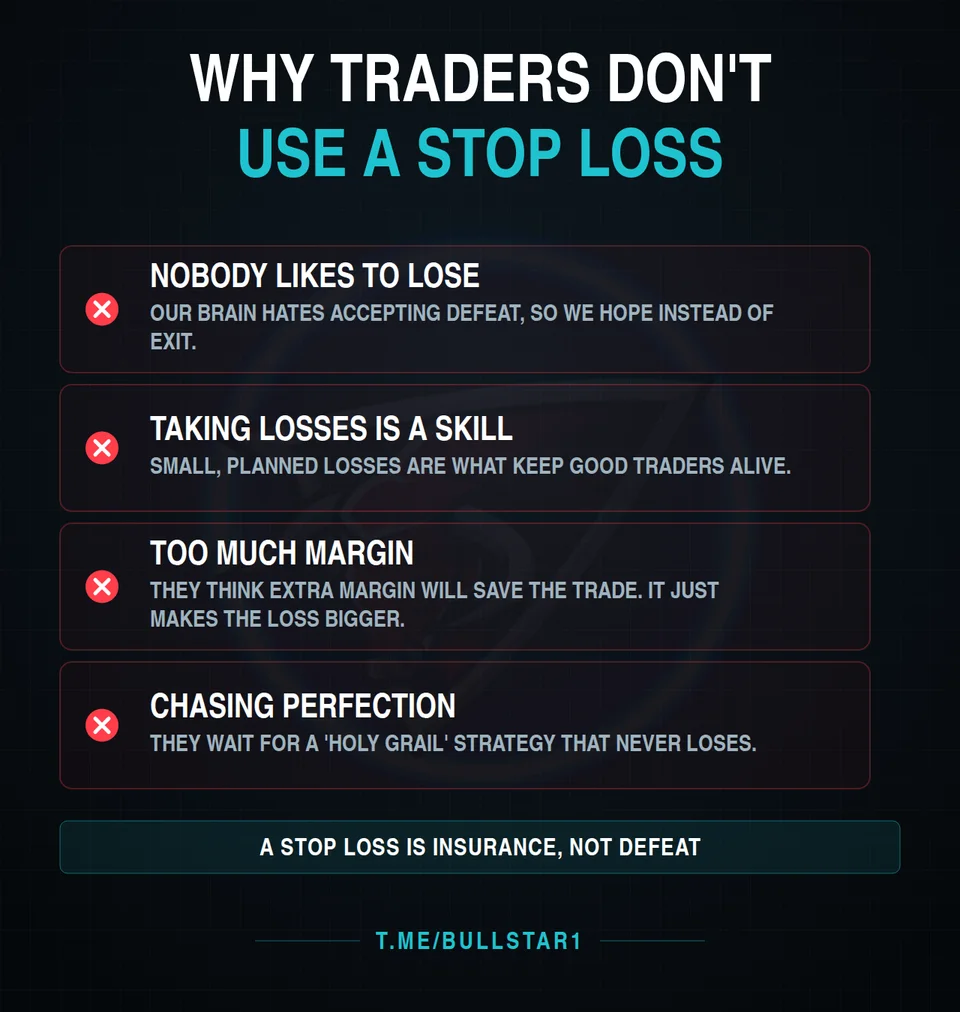
If stop losses are so important, why do so many traders skip them? Mostly psychology: nobody likes to lose, so they hope instead of exiting. Others believe extra margin will save the trade, which only makes the loss bigger, or they wait for a perfect strategy that never loses. A stop loss is insurance, not defeat.
How to Minimize Losses
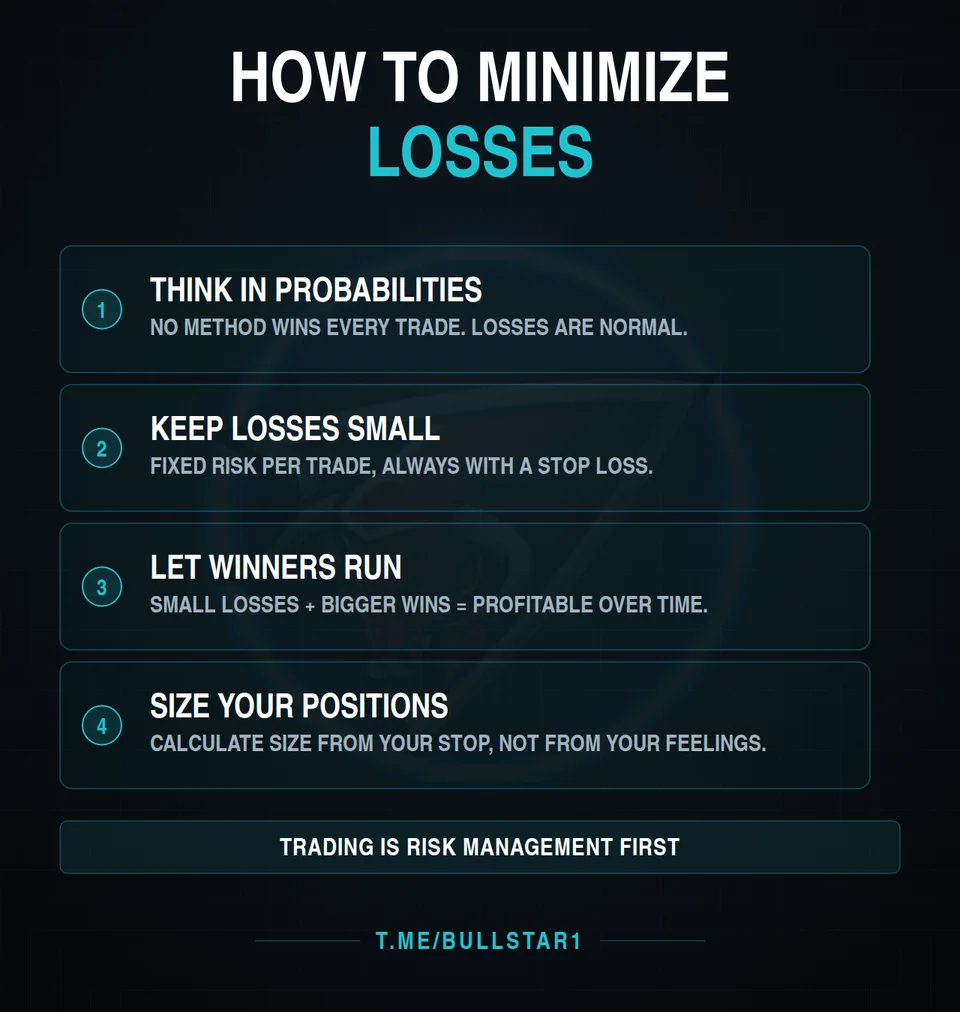
Losses are a normal part of trading. No method wins every trade. What separates profitable traders is that their losses are small and planned, and their winners are allowed to run. Keep a fixed risk per trade, always use a stop, and calculate your size from the stop. Our 5 risk management rules go deeper.
Every Bullstar signal comes with a stop loss already worked out, and we publish every result, stop losses included. You can see how the stops perform before you join.
Join Bullstar Signals free channelFrequently Asked Questions
Where should I put my stop loss in crypto?
Put your stop loss where your trade idea is proven wrong. For a long trade, that is usually just below the last swing low, a rising trendline or a key moving average. For a short, it is just above the last swing high. Leave a small buffer beyond the level so normal wicks don't take you out.
What percentage should a stop loss be in crypto?
There is no single right percentage. The stop should be based on the chart, not a fixed number, and the position size should then be adjusted so the loss equals 1-2% of your account. A 5% stop and a 15% stop can both risk the same 1% of your account if the position size is different.
Should I always use a stop loss in crypto?
Yes, especially with leverage. Crypto can move 10% or more in minutes, and without a stop loss a single trade can wipe out a large part of your account. A stop loss turns an unknown risk into a planned one.
Why does my stop loss get hit and then price reverses?
Usually because the stop was in an obvious place, right under support or right above resistance, where many other stops sit. Quick wicks often take out those stops before the real move. Placing the stop a little beyond the wicks, or using an ATR-based stop, helps.
What is the difference between stop market and stop limit?
A stop market order closes your position at the best available price once the trigger is hit, so it always fills but can slip in fast markets. A stop limit order only fills at your limit price or better, so it can avoid slippage but might not fill at all. For protecting a position, most traders use stop market.
Should I use mark price or last price for my stop loss on Binance Futures?
Mark price is less affected by short spikes on one exchange, so it can help avoid being stopped out by a sudden wick. Last price reacts faster to the actual traded price. Many futures traders use mark price for stop losses for that reason.
Should I move my stop loss to breakeven?
Moving the stop to breakeven after the first target is hit is a common way to remove risk from a trade. Don't do it too early, though: if you move it before price has had room to breathe, normal pullbacks will close the trade at zero.
What is a trailing stop loss?
A trailing stop moves with price as the trade goes in your favor, keeping a set distance behind it. It locks in profit in strong trends, but in choppy markets it can close good trades too early.
Final Thoughts
A good stop loss isn't a number you pick because it feels safe. It's the price where your trade idea is proven wrong, with a little room for normal noise. Place it below structure, a trendline, a moving average, an ATR distance or a pattern's invalidation point, keep it out of the obvious spots, and size your position so that hitting it costs only 1-2% of your account. Do that on every trade, and no single loss will ever be the one that ends your trading.
This article is for educational purposes only and is not financial advice. Crypto trading carries high risk, and stop losses can slip in fast markets.