 BULLSTAR
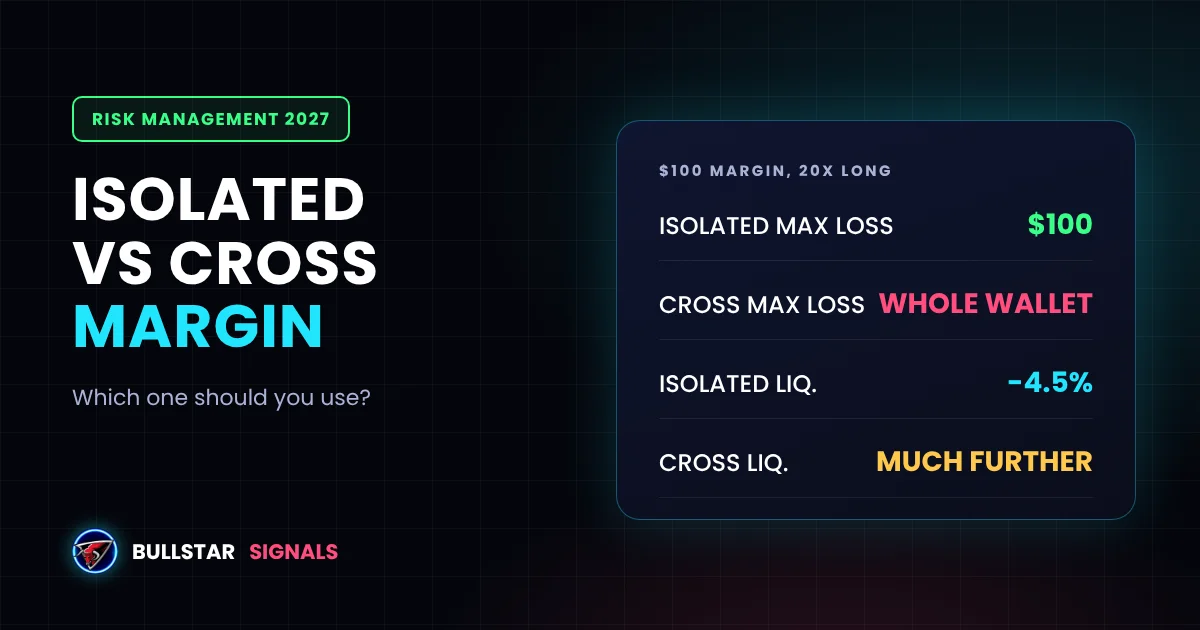
When you open a futures trade on Binance, Bybit or any other exchange, there is a small switch next to the leverage that most beginners never touch: Isolated or Cross. It looks like a detail. It isn't. That one setting decides how much of your money a single trade can take if things go wrong.
This guide explains both margin modes in plain words, shows real numbers for the same trade in each mode, and helps you decide which one to use. There is a calculator below where you can test your own trade.
- Isolated margin: only the margin you put into a trade is at risk. If it gets liquidated, the rest of your balance is safe.
- Cross margin: your whole futures balance backs every open trade. Liquidation is further away, but one bad trade can wipe the whole account.
- Which to use: isolated for most traders, especially beginners and anyone following signals. Cross only when you know exactly why you need it.
What Is Margin in Crypto Futures?
Margin is the money you put up to open a leveraged position. With 20x leverage, $100 of margin opens a $2,000 position. If the trade moves against you, the loss comes out of your margin. When the margin left is too small to keep the position open, the exchange closes it for you. That is liquidation.
The margin mode decides which money the exchange is allowed to use to cover those losses: only the margin of that trade, or everything in your futures wallet.
Isolated vs Cross Margin: The Difference
Isolated margin
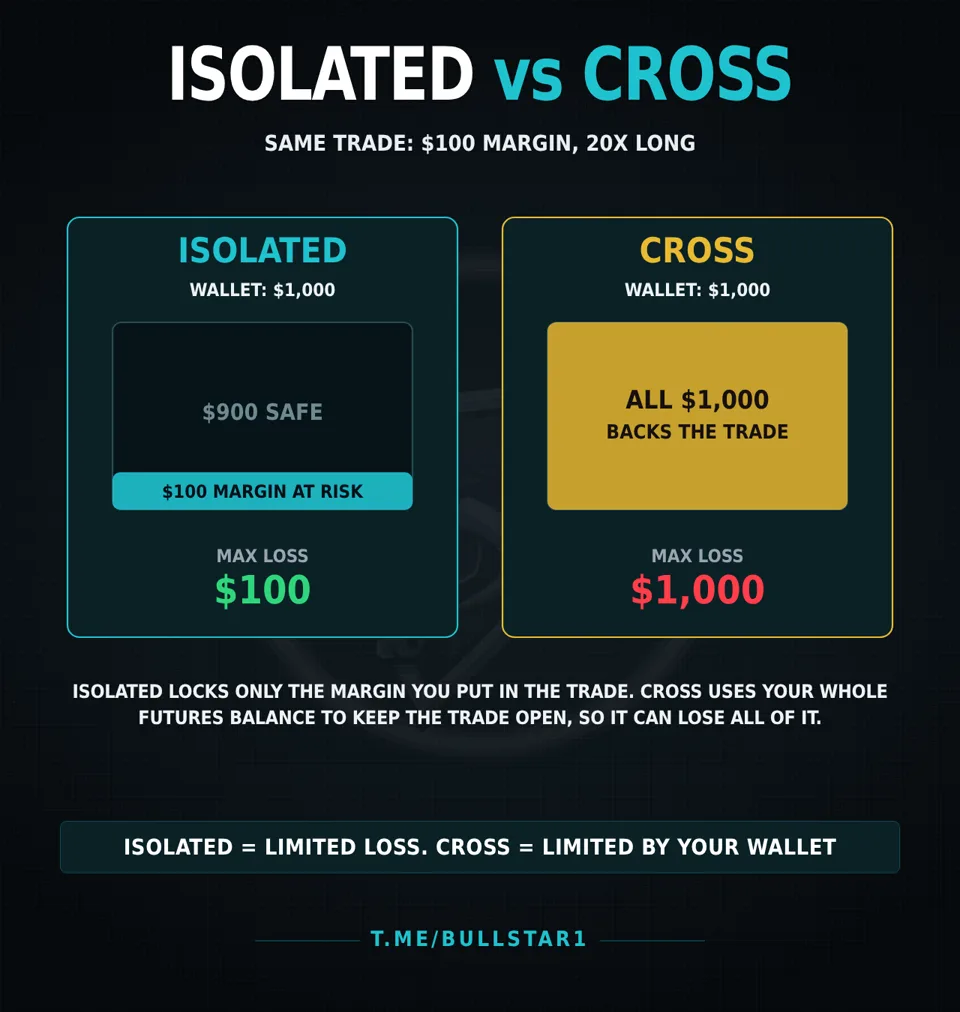
With isolated margin, each position gets its own separate margin. If you put $100 into a trade, that $100 is the most it can lose. When losses reach that amount, the position is liquidated and the rest of your balance is not touched.
Because only $100 protects the trade, liquidation comes quickly at high leverage. At 20x, a move of around 4.5% against you is enough.
Cross margin
With cross margin, all your available futures balance is shared by every open position. If a trade goes against you, the exchange keeps pulling money from your balance to keep it open. Liquidation only happens when your whole balance can no longer cover the losses.
That pushes the liquidation price much further away. It sounds safer, and it is the reason many people pick cross. But the price of that extra room is that the trade can now lose much more than the margin you planned to risk.
| Isolated | Cross | |
|---|---|---|
| Money at risk | Only that trade's margin | Whole futures balance |
| Liquidation price | Closer to entry | Further from entry |
| Positions affect each other | No | Yes, they share one balance |
| Worst case | Lose one trade's margin | Lose the whole account |
| Best for | Beginners, signal followers, several trades | Hedging, experienced traders |
Same Trade, Two Modes: Real Numbers
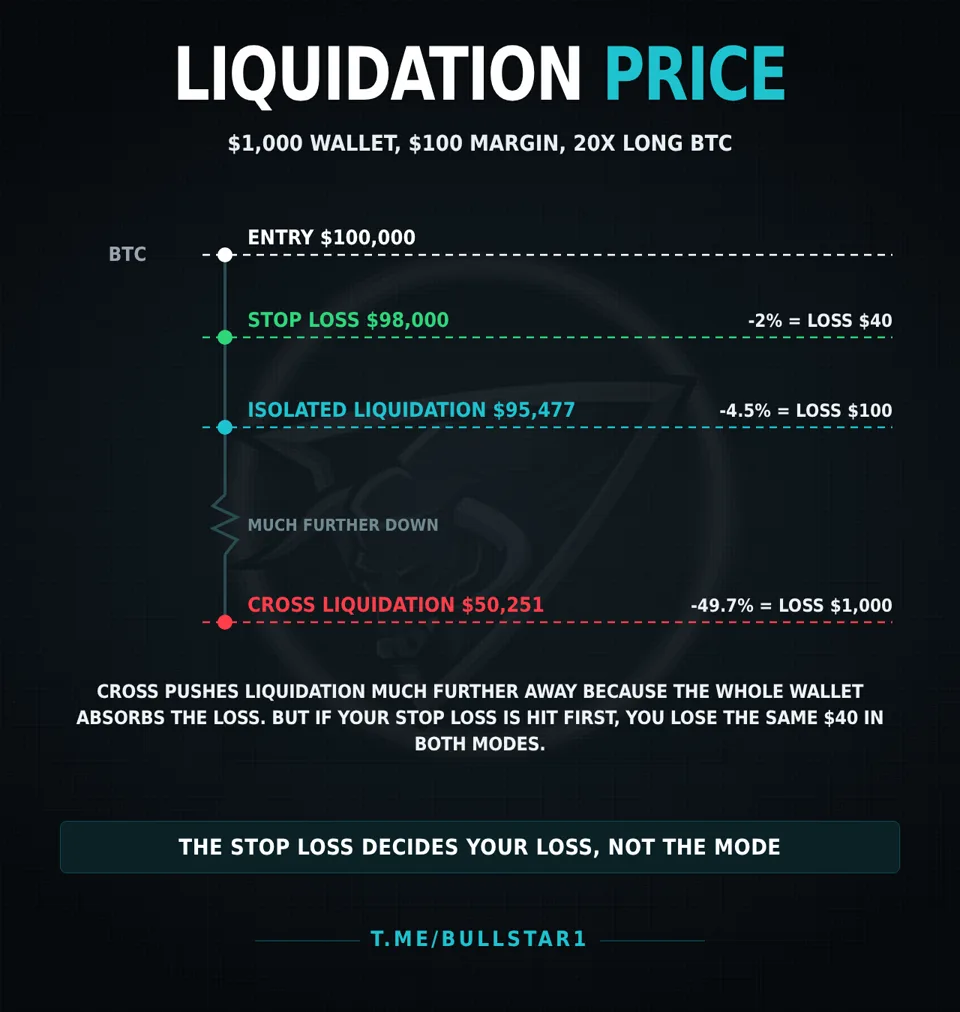
Say you have $1,000 in your futures wallet and open a 20x long on Bitcoin at $100,000 with $100 of margin. That is a $2,000 position.
- Isolated: liquidation at about $95,477, a drop of 4.5%. Maximum loss: $100.
- Cross: liquidation at about $50,251, a drop of almost 50%. Maximum loss: $1,000, the whole wallet.
Now add a stop loss 2% below entry, at $98,000. If price hits it, you lose $40 in both modes. The stop closes the trade long before either liquidation price is reached.
That is the most important point in this whole guide: with a stop loss, your loss is decided by the stop, not by the margin mode. The margin mode only matters when something goes wrong: you forgot the stop, the stop was not set on the exchange, or price gapped through it in a violent move. Isolated is what limits the damage in those moments.
Isolated vs Cross Margin Calculator
Enter your trade to compare the liquidation price and the maximum loss in both modes.
The Hidden Risk of Cross Margin: One Bad Trade Takes All
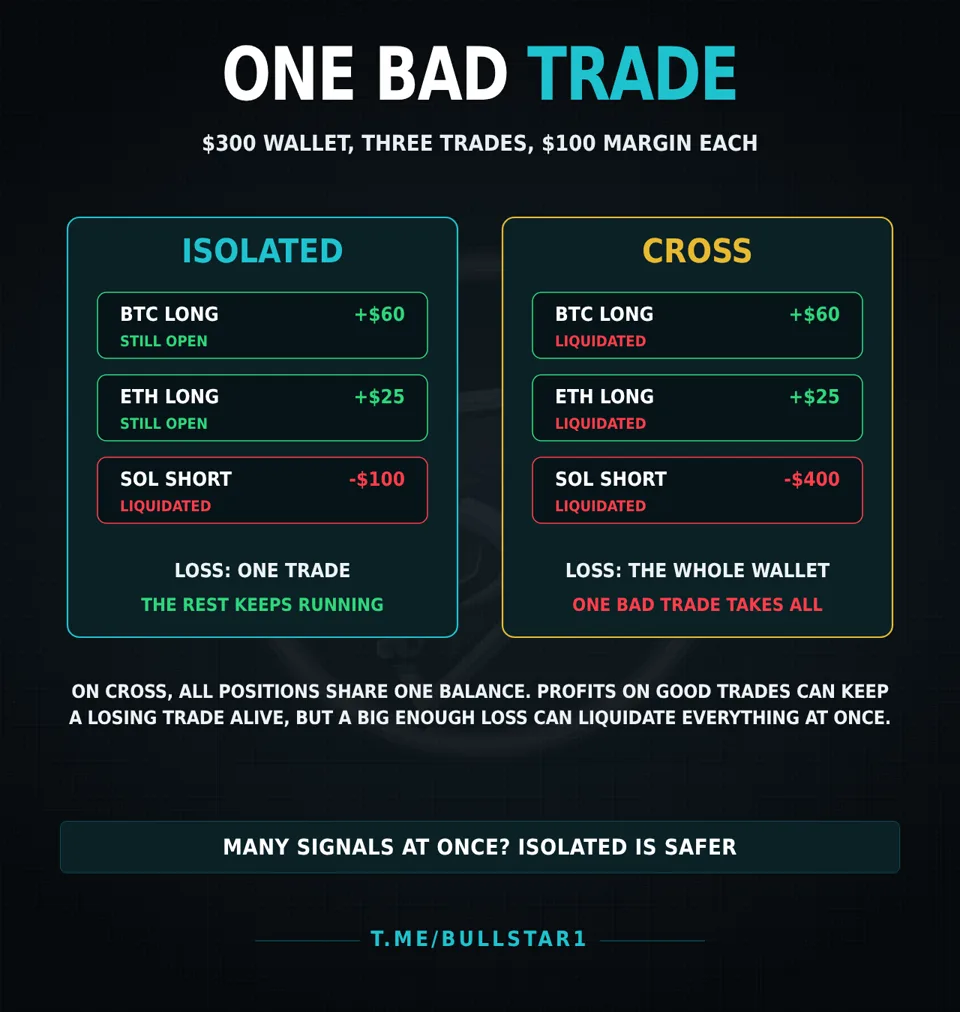
The real danger of cross margin shows up when you have several trades open at once, which is normal if you follow a signals channel.
On cross, every position draws from the same balance. Profits on your winning trades can keep a losing trade alive for longer. That feels good until the losing trade keeps going. Once the combined loss is bigger than your balance, the exchange liquidates all your positions at once, including the ones that were in profit.
On isolated, the same losing trade is liquidated on its own. You lose that trade's margin, and the other two keep running.
Cross margin also hides a trap that some signal channels use: with the whole wallet behind a trade, a position can sit deep in loss for days without being liquidated, then recover and be posted as a "win". We explained how this inflates win rates in The Stop Loss Secret.
Which Margin Mode Should You Use?
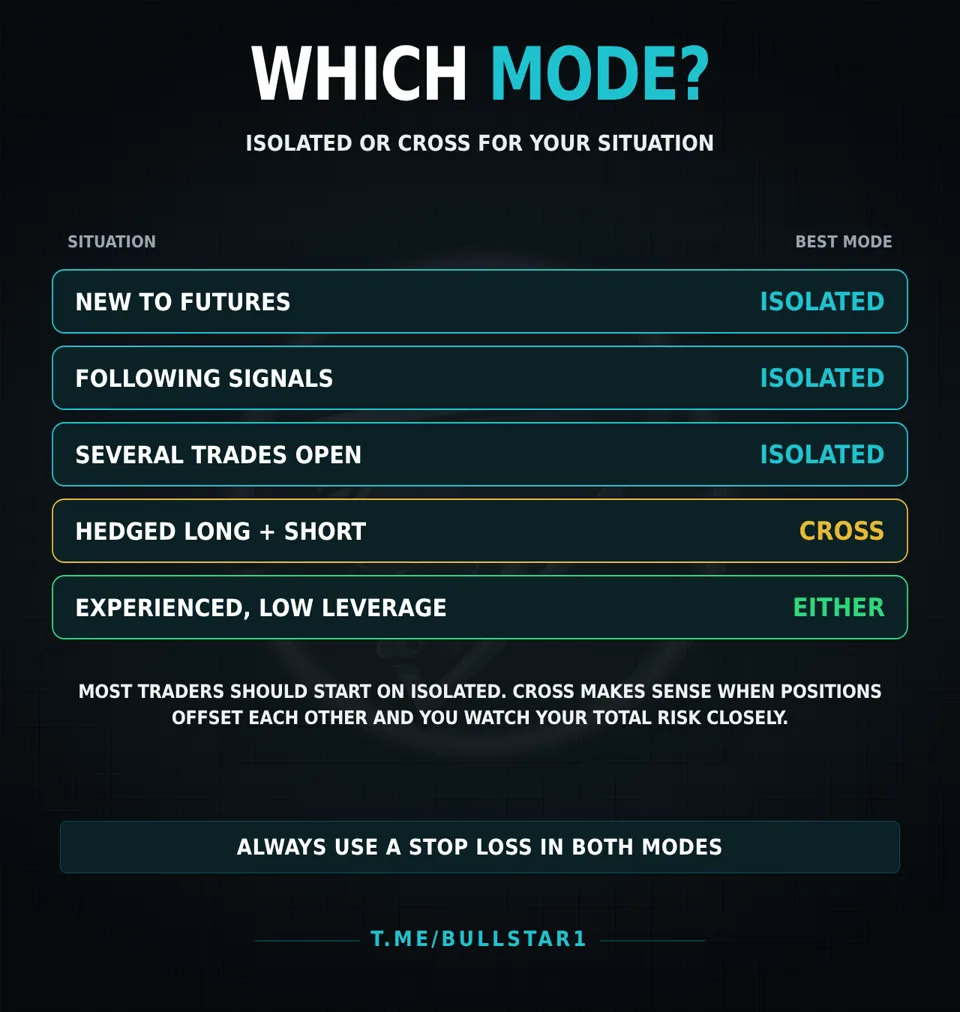
Use isolated if:
- You are new to futures.
- You follow signals and often have several trades open.
- You want each trade's risk to be fixed and easy to calculate.
- You use higher leverage, where a sudden wick can do real damage.
Cross can make sense if:
- You hold positions that offset each other, like a long and a short hedge, and want them to share margin.
- You trade with low leverage and a balance sized for the trades you take.
- You watch your total account risk closely and always use stop losses.
For most people the answer is simple: isolated by default. It turns "how much can I lose?" into a number you choose before the trade, not one the market chooses for you.
How to Switch Margin Mode on Binance and Bybit
- Open the futures trading page for the coin you want to trade.
- Above the order form, tap the margin mode button. It shows Cross or Isolated.
- Choose Isolated and confirm.
- Set your leverage next to it, then place the order as usual.
The setting is saved per trading pair, so check it on every new coin. Most exchanges do not let you change the margin mode while you have an open position or open orders on that pair, so set it before you enter. If you are new to the Binance futures screen, our step-by-step Binance futures guide walks through every button. Bybit's newer Unified Trading Account also offers a portfolio margin mode, which works like an advanced version of cross and is meant for experienced traders.
Margin Mode Mistakes to Avoid
- Thinking cross is safer because liquidation is further away. It only moves liquidation by putting more of your money at risk.
- Trading without a stop loss on cross. This is how accounts get wiped in one night.
- Using all your balance as margin on isolated. Isolated only protects you if the margin is a small part of your account. Size it with our position size calculator.
- Adding margin to a losing isolated trade again and again. That is just turning it into cross margin by hand.
- Forgetting the mode is set per pair. A coin you traded months ago may still be on cross.
- Using high leverage because the mode feels safe. Neither mode fixes oversized positions. See leverage explained.
What Margin Mode Do We Use for Signals?
We recommend isolated margin for every Bullstar signal. Each signal comes with an entry zone, take-profit targets and a stop loss, and isolated keeps the risk of each one separate, so a single bad trade can never touch the rest of your account. If you auto-trade our signals with Cornix, you can set the margin mode to isolated in its settings once and it applies to every trade.
You can see how every VIP signal since 2022 played out, losses included, on our results page, or follow the free Telegram channel to see the signals live.
Not financial advice. Crypto futures trading with leverage carries high risk and you can lose your entire margin.