 BULLSTAR
Last updated: November 1, 2026
If you want to start a crypto business in Canada, the first registration you need is with FINTRAC, Canada's financial intelligence unit. Every business that exchanges or transfers crypto for clients is a money services business (MSB) and must register before it offers a single service.
This guide walks through the FINTRAC MSB registration step by step: who needs it, the documents you need, how the forms work, how long it takes, your obligations after you're registered and what changed in 2026. If you want the bigger picture of crypto regulation in Canada, including securities rules and CIRO, read our guide to the crypto license in Canada.
- Who: any business that exchanges or transfers crypto for clients, including foreign businesses serving Canadians.
- When: before you start. You cannot operate while the application is pending.
- Cost: no FINTRAC fee. The cost is your compliance program.
- Time: most complete applications are processed within about 3 months.
- Renewal: every 2 years. Changes must be reported within 30 days.
- New in 2026: penalties are up to 40 times higher, and FINTRAC revoked 82 MSB registrations in its last fiscal year.
Do You Need FINTRAC Registration?
Since June 1, 2020, Canada's anti-money laundering law treats businesses that deal in virtual currency as money services businesses. In practice that means two activities:
- Exchanging crypto for clients: crypto to cash, cash to crypto, or one crypto to another.
- Transferring crypto for clients from one person or address to another.
If you do either one as a business, you need to register. Here is how common business types usually fit:
| Business | Register with FINTRAC? | Notes |
|---|---|---|
| Crypto exchange or trading platform | Yes | Also needs securities registration if it holds client assets |
| Crypto ATM operator | Yes | One of FINTRAC's focus areas in 2026 |
| OTC desk or crypto broker | Yes | Exchanging crypto for cash or other crypto counts |
| Payment processor that accepts or sends crypto for clients | Usually yes | Depends on whether it transfers crypto for clients |
| Foreign exchange serving Canadians | Yes, as a foreign MSB | Applies even with no office in Canada |
| Stablecoin issuer | Coming | The new federal stablecoin law will require MSB registration once in force |
| Company that only holds crypto for itself | No | Investing your own money is not a money service |
| Online shop that accepts crypto as payment | Usually no | Getting paid in crypto for your own goods is not a money service |
| Software or wallet provider that never controls client funds | Usually no | Get legal advice, the line can be thin |
The edge cases are tricky, especially for wallets, DeFi front ends and payment tools. If you are not sure, get advice from a Canadian lawyer before you launch. FINTRAC can also give a written interpretation.
Domestic MSB or Foreign MSB?
There are two kinds of registration:
- Domestic MSB: your business has a place of business in Canada.
- Foreign MSB: your business has no place of business in Canada, but directs services at people in Canada and provides those services to them. Signs that you are directing services at Canadians include Canadian marketing, Canadian domain names, Canadian dollar trading or Canadian clients on your platform.
A foreign MSB must appoint a representative for service who lives in Canada and can receive FINTRAC notices. The representative is only a contact point. The foreign business itself stays fully responsible for every obligation.
This is not a formality. Binance and KuCoin were both fined by FINTRAC for serving Canadians without registering as foreign MSBs.
Before You Apply: Build Your Compliance Program
FINTRAC expects your anti-money laundering (AML) program to exist before you apply, not after. Since 2026 the law also says it must be reasonably designed, risk-based and effective, so a copied template is not enough. A compliance program has five required parts:
- A compliance officer with the authority and resources to run the program.
- Written policies and procedures, kept up to date and approved by a senior officer. They cover client identification, reporting, record keeping, the travel rule, sanctions screening and ministerial directives.
- A documented risk assessment of your money laundering, terrorist financing and sanctions evasion risks, based on your clients, products, delivery channels and locations.
- A written training program for employees and agents.
- An effectiveness review at least every two years, by an internal or external auditor, reported to a senior officer within 30 days.
For a crypto business, the program should also cover blockchain analytics and wallet screening, how you collect travel rule information, and how you spot clients trying to stay anonymous.
Documents and Information You'll Need
| What | Details |
|---|---|
| Certificate of incorporation (or equivalent) | Shows the legal entity and its directors |
| Ownership and control chart | Everyone who owns or controls 20% or more, up to the real people at the top |
| Criminal record checks | For the CEO, president, every director and every 20%+ owner, issued in the last 6 months by their country of residence, with a certified English or French translation if needed |
| Compliance officer details | Name and contact of the person in charge of your AML program |
| Bank account details | The accounts your business uses |
| Services and expected volumes | Each money service you offer and the yearly volume you expect for each |
| Locations and agents | Every location, and every agent or mandatary acting for you |
| Canadian representative (foreign MSBs) | A person resident in Canada who can receive FINTRAC notices |
Collecting ownership documents and criminal record checks is the most common cause of delays, especially when owners and directors live in different countries.
Some people can't be part of an MSB at all. A business can be refused or lose its registration if, for example, the business or someone who controls it has been convicted of certain crimes, such as money laundering, terrorist financing or certain fraud and drug offences, or is subject to Canadian sanctions.
How to Register With FINTRAC: Step by Step
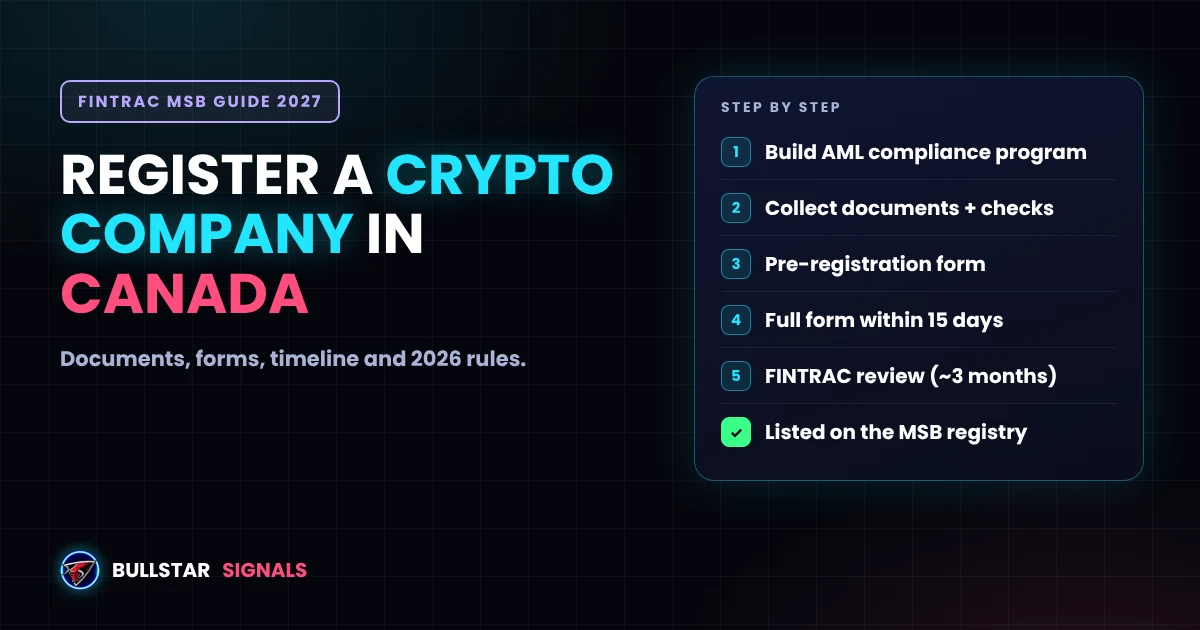
- Fill in the pre-registration form on FINTRAC's website. It asks for basic details about your business and a contact person.
- Get the registration form. FINTRAC sends you the full registration form through its Secure Document Transfer System. You need to set a secure access code to use it.
- Complete it within 15 days. The link expires 15 days after you receive it. If you miss the window, the application closes and you start again.
- Upload your documents, such as incorporation papers, the ownership chart and criminal record checks.
- Answer FINTRAC's questions. FINTRAC often asks for clarifications. You have 30 days to answer each request, or the application is denied.
- Get your registration number. Once approved, FINTRAC gives you an MSB registration number and your business appears on its public MSB registry. Banks and partners check this list, so make sure the details are right.
You can't offer money services while your application is pending. Exchanging or transferring crypto for clients before you are registered is an offence, even if your application is already submitted.
How Long Does It Take?
| Stage | Typical time |
|---|---|
| Decide your services, structure and provinces | 1 to 2 weeks |
| Build your compliance program and collect documents | 2 to 6 weeks (criminal record checks can be the slowest part) |
| Pre-registration form | 1 day |
| Full registration form | Must be completed within 15 days of getting the link |
| FINTRAC review | Most complete applications within about 3 months |
| Answering FINTRAC questions | Within 30 days of each request, or the application is denied |
All in, a well-prepared business should plan for about three to five months from start to registration. Securities registration, if your platform holds client assets, takes much longer.
How Much Does It Cost?
FINTRAC charges no application fee and no yearly fee, and there is no minimum capital requirement for MSB registration. The real costs are elsewhere:
- A compliance officer, in-house or outsourced.
- Legal advice on your structure, especially if you also need securities registration.
- Blockchain analytics, sanctions screening and travel rule software.
- The effectiveness review every two years.
- Criminal record checks and translations.
Prices vary a lot between providers, so ask for quotes from more than one. A bank account is a separate challenge: FINTRAC registration does not oblige any bank to work with you, and Canadian banks treat crypto businesses as high risk. Start talking to banks early.
Your Obligations After Registration
Registration is the start, not the finish. Once you're registered, these duties apply every day:
| Duty | When it applies | Deadline |
|---|---|---|
| Know your client | Verify the identity of a client who exchanges $1,000 or more in crypto in one transaction | Before the transaction is completed |
| Large virtual currency transaction report (LVCTR) | Receiving $10,000 or more in crypto in one transaction, or in several within 24 hours (24-hour rule) | Within 5 working days |
| Suspicious transaction report (STR) | Any amount, when you have reasonable grounds to suspect money laundering or terrorist financing | As soon as practicable |
| Travel rule | Send and keep sender and receiver information with crypto transfers of $1,000 or more | With every transfer |
| Listed person or entity property report | You hold property of a terrorist group or a sanctioned person | Immediately |
| Record keeping | Client, transaction and report records | Keep at least 5 years |
| Effectiveness review | Independent test of your whole compliance program | At least every 2 years |
| Registration renewal | Renew your FINTRAC registration | Every 2 years, before it expires |
| Changes to your registration | New owner, director, agent, service, address or compliance officer | Within 30 days |
FINTRAC also checks registered businesses through examinations. It looks at whether you actually follow your written program, not just whether you have one.
If You Use Agents
Many MSBs work through agents, such as crypto ATM hosts or partner businesses. Since October 1, 2025, you must check that each agent is eligible before you engage them, and repeat the check every two years. For a business agent, that means criminal record checks for its CEO, president, directors and 20%+ owners. Agents engaged before October 2025 must be checked by October 1, 2027. Agents don't register separately, but you must list them in your registration.
Quebec Has Its Own Licence
Quebec runs its own licence for money services businesses under the provincial Money-Services Businesses Act, managed by Revenu Quebec. If your business operates in Quebec, you need this licence in addition to FINTRAC registration, and you can't offer money services there until it is issued. Revenu Quebec asks for security clearance reports from the police, which take extra time.
Do You Also Need Securities Registration?
FINTRAC registration covers anti-money laundering only. If your platform holds crypto or cash for clients, it is usually a crypto trading platform under securities law. That means registering with the provincial securities regulators, normally as an investment dealer and member of CIRO. This is a much bigger project with capital, custody and insurance rules.
We cover this second layer in detail in our guide to the crypto license in Canada.
What Changed in 2026
Canada has become much stricter with crypto businesses:
- Penalties up to 40 times higher. Law changes that received royal assent on March 26, 2026 raised FINTRAC's maximum penalties to $40,000 for a minor violation, $4 million for a serious one and $20 million for a very serious one. Total penalties for a business can reach $20 million or 3% of global revenue, whichever is higher.
- Program quality is now the law. Compliance programs must be reasonably designed, risk-based and effective, and FINTRAC can penalize a program that exists on paper but doesn't work.
- More revocations. FINTRAC revoked the registrations of 82 money services businesses in its 2025-26 fiscal year, up from 12 the year before, and imposed penalties of more than $198 million on nine MSBs. Many of the revoked businesses were crypto firms.
- Stablecoins are next. Canada's new stablecoin law will require stablecoin issuers to register with FINTRAC as MSBs once the rules come into force.
- Enrolment for everyone. Other reporting entities that don't register today will have to enrol with FINTRAC, starting from 2027.
Recent FINTRAC Penalties for Crypto Businesses
| Business | Announced | Penalty | Main violations |
|---|---|---|---|
| Cryptomus (Xeltox Enterprises) | Oct 2025 | About C$177 million | Failed to report suspicious transactions, including links to cybercrime, and other program failures |
| KuCoin (Peken Global) | Sep 2025 | About C$19.5 million | Did not register as a foreign MSB, did not report large crypto transactions or suspicious transactions |
| Binance | May 2024 | C$6 million | Did not register as a foreign MSB and did not report large crypto transactions |
The Cryptomus penalty was the largest FINTRAC has ever imposed. All three cases came before the 40 times higher penalty limits, so future fines can be much bigger.
How to Check if a Crypto Company Is Registered
Anyone can search FINTRAC's public MSB registry by company name or registration number. A registered crypto business should show as active, with "dealing in virtual currencies" among its services. The registry also lists revoked and expired registrations.
For traders, this is a quick way to check an exchange before you send it money. For an exchange to be fully legal in Canada, it should also appear on the CSA's list of authorized crypto trading platforms. Our guide to crypto exchanges in Canada lists the ones that work for Canadians.
FINTRAC Registration Checklist
- Confirm you are an MSB dealing in virtual currency, domestic or foreign
- Incorporate and map ownership down to every 20%+ owner
- Appoint a compliance officer (and a Canadian representative if foreign)
- Write your policies, risk assessment and training program
- Set up client verification, wallet screening and the travel rule
- Collect criminal record checks issued in the last 6 months
- Submit the pre-registration form, then the full form within 15 days
- Answer FINTRAC within 30 days of each request
- Check your listing on the MSB registry
- Plan Quebec licensing and securities registration if they apply
- Calendar your 2-year renewal and effectiveness review
Frequently Asked Questions
Do I need to register with FINTRAC to run a crypto business in Canada?
Yes, if your business exchanges crypto for cash or other crypto, or transfers crypto for clients. These businesses are money services businesses (MSBs) dealing in virtual currency, and they must register with FINTRAC before they start. Foreign businesses that serve people in Canada must register as foreign MSBs.
How long does FINTRAC MSB registration take?
FINTRAC says most complete applications are processed within about three months. Preparing the compliance program and documents usually takes several weeks before that. Incomplete applications take longer or are denied.
How much does it cost to register a crypto company with FINTRAC?
FINTRAC charges no registration fee and no yearly fee. The real cost is building a compliance program, hiring or appointing a compliance officer, legal advice and the effectiveness review every two years.
Can I operate while my FINTRAC registration is pending?
No. You must be registered before you offer money services, including exchanging or transferring crypto. Operating while unregistered is an offence and can lead to large penalties.
Can a foreign crypto company register with FINTRAC?
Yes. A business outside Canada that directs services at people in Canada and provides those services to them must register as a foreign MSB. It needs a representative for service who lives in Canada, and it must meet the same reporting and record keeping rules.
Is FINTRAC registration a crypto license?
Not exactly. FINTRAC registration covers anti-money laundering. Crypto trading platforms that hold client assets usually also need securities registration with provincial regulators and CIRO, and businesses in Quebec need a separate licence from Revenu Quebec.
What happens if a crypto business does not register with FINTRAC?
FINTRAC can impose administrative penalties, and since March 2026 the maximum penalties are 40 times higher, up to $20 million for a very serious violation. Binance and KuCoin were both fined for serving Canadians without registering as foreign MSBs.
This guide is general information based on FINTRAC guidance and public reports as of November 2026. It is not legal or financial advice. Rules change often, so check FINTRAC's website and speak to a Canadian lawyer before you apply.