 BULLSTAR
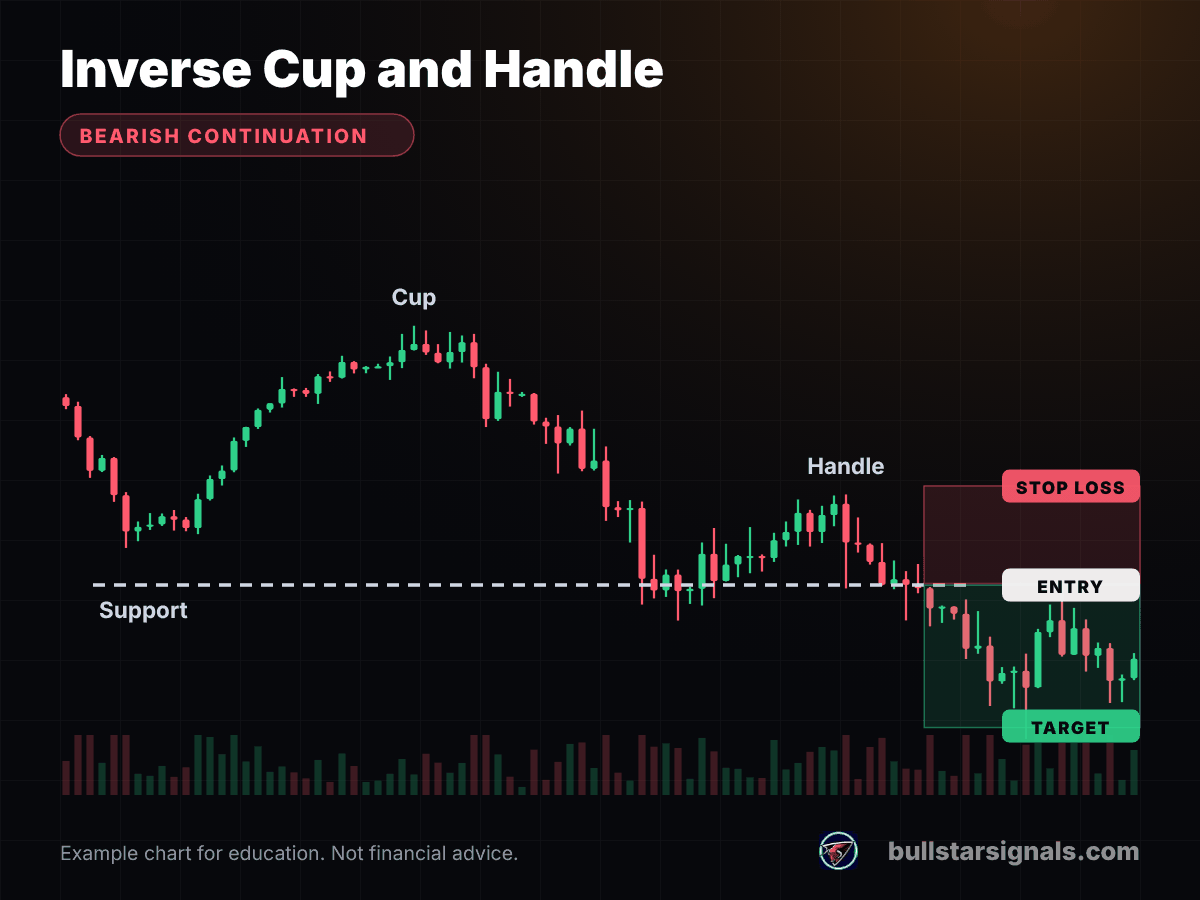
Inverse Cup and Handle Pattern
An upside-down cup and a small bounce (the handle) above the old low.
What is the Inverse Cup and Handle?
The Inverse Cup and Handle is a bearish chart pattern. An upside-down cup and a small bounce (the handle) above the old low. It is a continuation pattern, which means it usually appears in the middle of a trend and signals a pause before the move resumes.
Like every chart pattern, it only counts once price confirms it by closing through the key level. Until then it is just a shape that might fail.
What it tells you about buyers and sellers
The upside-down cup is a slow climb that fails at an old low, then a roll back down. The handle is a small bounce that gives late sellers a second chance. When support breaks, the slow distribution turns into a fast move.
How to trade it
Short on a close below support.
Above the handle.
The height of the cup, measured down from support.
Size the position from the distance to the stop loss, so a loss costs only 1 to 2% of your account. See our position size guide and where to put a stop loss.
Example trade
Imagine AVAX rising from 30 to 42 and back to 30 in a dome on the daily chart, then bouncing to 34 for the handle. A close at 29.5 is the short, stop above 34.5, target near 17.5, the 12 point cup height below support. This is a hypothetical example to show the method, not a real trade or a forecast.
Common mistakes
- Entering before a candle closes beyond the breakout line. Crypto wicks through levels all the time and snaps back.
- Trading the pattern against the bigger trend on a higher time frame.
- Ignoring volume. A breakout on low volume fails more often.
- Placing the stop loss too tight, inside the noise of the pattern.
FAQ
Is the Inverse Cup and Handle bullish or bearish?
The Inverse Cup and Handle is bearish. It is a continuation pattern. Price tends to move lower after it confirms, but no pattern works every time.
How reliable is the Inverse Cup and Handle in crypto?
We rate its reliability as medium. It works best on the 1D chart or higher and when volume confirms the move. Always use a stop loss, because patterns fail often in a market as volatile as crypto.
Where do you put the stop loss on a Inverse Cup and Handle?
Above the handle.
The chart is an illustration for education. Not financial advice. Crypto trading carries a high risk of loss.
 Head and Shoulders
 Double Top
 Triple Top
 Ascending Triangle